The statute drawsits line throughthe plant.
The Narcotic Drugs and Psychotropic Substances Act, 1985 does not prohibit a species. It prohibits certain parts of one, and leaves other parts to state excise departments. Everything confusing about cannabis law in India follows from that single drafting decision.
General information, not legal advice. Thresholds are set by notification and have been amended before; state rules change without announcement. If a case is involved, speak to a criminal lawyer.
§2(iii)
Defines cannabis by part of plant: charas, ganja, and any mixture of either. Leaves and seeds not accompanied by the tops fall outside it.
§20
The offence and its three penalty bands: small, intermediate, commercial. The band, not the conduct, decides the sentence.
§10 and §14
Powers left to the states, and the licence route for industrial hemp and horticulture. This is the opening Uttarakhand and others have used.
§64A
Immunity from prosecution for a dependent user charged with a small quantity who volunteers for treatment. Rarely invoked, still on the books.
Where a weight falls decides years of someone’s life
The band determines whether bail is realistic and whether a sentence is measured in months or in decades. Note that the notified quantity is of the whole seized mixture, not of pure THC, a point that has produced years of appellate litigation.
| Substance | Small quantity | Commercial quantity | Penalty range |
|---|---|---|---|
| Ganja (flowering tops) | 1 kg | 20 kg | Small quantity: up to 1 year, or fine. Intermediate: up to 10 years rigorous imprisonment. Commercial: 10 to 20 years rigorous imprisonment with fine, and bail effectively barred by §37. |
| Charas or hashish | 100 g | 1 kg | |
| Hash oil | 100 g | 1 kg | |
| Bhang (leaves and seeds alone) | Outside the NDPS definition of cannabis | Governed by state excise law. See the lookup below. | |
Consumption is its own offence
§27 punishes consumption itself, up to six months for cannabis or a fine. It is the provision most often used against ordinary users.
Repeat offences escalate hard
§31 raises the maximum by half on a second conviction, and §31A reaches the death penalty for repeat commercial-quantity trafficking of certain drugs, now discretionary rather than mandatory.
Procedure is where cases turn
Search, seizure, sampling, and the §50 right to be searched before a magistrate or gazetted officer are litigated constantly. Many acquittals are procedural rather than factual.
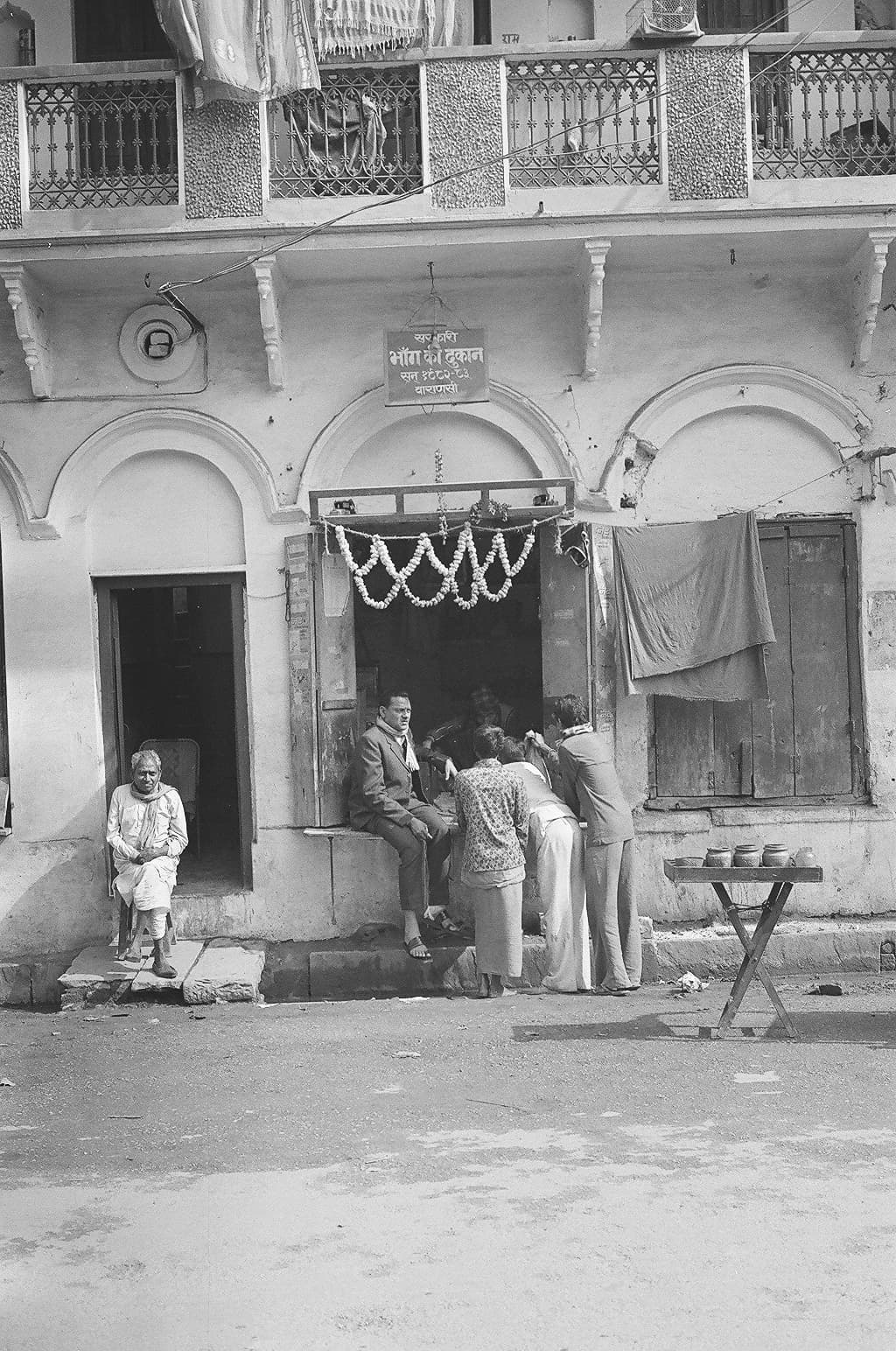
A government-licensed shop, selling a plant preparation, on a public street
Uttar Pradesh has run licensed bhang shops like this one for decades, most visibly in pilgrimage towns such as Varanasi and Mathura. It is the clearest possible illustration of the state-by-state patchwork below: the same plant, sold openly under one label and prosecuted under another a few kilometres away.
One Act, many different lived realities
Because bhang and hemp cultivation sit with the states, the practical answer to “is it legal here” changes at every border. Filter below. Every entry carries a confidence label, because parts of this are genuinely hard to source.
Confirmed: traceable to an Act, rule or gazette notification. Reported: consistently described in press and policy writing, primary source not yet linked. Unclear: contested or changing, so treat with caution.
Uttarakhand
Hemp licensingConfirmedThe first state to license industrial hemp cultivation under NDPS §14, from 2018, with a THC ceiling for licensed crops and permits issued district by district for fibre and seed.
On the ground: Licensing is real but slow, and acreage remains modest. Wild cannabis grows abundantly across the hills regardless of any permit.
Madhya Pradesh
Hemp and bhangConfirmedNotified rules permit hemp cultivation for industrial and horticultural purposes, and the state excise department has historically licensed bhang shops in several districts.
On the ground: Bhang sale is a familiar part of local commerce in parts of the state, while ganja and charas cases proceed under the NDPS Act as usual.
Uttar Pradesh
Licensed bhangConfirmedState excise rules provide for licensed bhang shops, most visibly in Varanasi, Mathura and other pilgrimage towns, with government-authorised sale of leaf preparations.
On the ground: Licensed shops operate openly, including around festivals. The licence covers bhang only, and the distinction is enforced inconsistently.
Rajasthan
Licensed bhangConfirmedExcise-licensed bhang outlets have long operated, and bhang preparations are a fixture of Holi commerce in Jaisalmer, Pushkar and elsewhere.
On the ground: Widely available in tourist towns. The gap between what a licence permits and what is actually sold is a recurring enforcement problem.
Odisha
Historic bhang licensingReportedLong described as a state where excise-licensed bhang sale persisted after 1985, alongside significant cultivation in the interior districts.
On the ground: Among the states most associated with large ganja seizures, so licensed leaf trade and heavy trafficking enforcement sit side by side.
Assam
Prohibited by state lawConfirmedThe Assam Ganja and Bhang Prohibition Act, 1958 predates the NDPS Act and bans sale, possession and consumption of ganja and bhang across the state.
On the ground: Both the plant and the leaf preparation are prohibited here, so the bhang exemption other states rely on does not apply.
Himachal Pradesh
Reform under discussionUnclearNo legal cultivation for cannabis at present, but a state assembly committee has examined controlled cultivation for industrial and medical use, and the question is live in policy debate.
On the ground: Traditional cultivation continues in the Kullu and Malana belts outside any legal framework, with periodic eradication drives.
Maharashtra
Bhang tolerated, not clearly licensedUnclearState excise law addresses bhang, and preparations circulate around festivals, but a clear current licensing regime is difficult to document from primary sources.
On the ground: Enforcement is city-dependent. Mumbai and Pune police pursue NDPS cases actively, including against small quantities.
Delhi
No licensed saleReportedNo licensed bhang retail regime is documented for the capital, and cannabis matters are handled straightforwardly under the NDPS Act.
On the ground: Small-quantity §27 cases are common. Bhang appears informally at Holi without any evident licensing basis.
Kerala
Strict enforcementReportedNo bhang licensing regime, and the excise department pursues cannabis cases vigorously, including possession at the small-quantity end.
On the ground: Among the most active enforcement environments in the country, with frequent campus and transport-hub operations.
Gujarat
Prohibition stateReportedAlcohol prohibition shapes the wider regime, and there is no licensed bhang trade. Cannabis is dealt with under the NDPS Act.
On the ground: Enforcement is consistent and public. Seizure announcements are a regular feature of state policing.
Tripura
Cultivation and eradicationReportedNo legal cultivation route, but the state is repeatedly identified in official reporting as a significant source of illicit cannabis for the north-east and beyond.
On the ground: Eradication drives run seasonally, and cultivation returns to the same districts afterwards.
A clickable map of this is next on our list, built from real boundary data rather than a drawing, which is why it is not here yet. If you can help source state excise notifications, that is the most useful thing you could give this project.