Three thousandyears, then fortyof silence.
Cannabis was not smuggled into Indian life. It arrived in the hymns, stayed in the pharmacopoeia, paid tax to a colonial excise department, and only became a criminal matter in living memory. Drag the timeline to follow how.
c. 1500 BCE
Step 1 of 9
The Atharvaveda names bhanga among the sacred plants
The earliest surviving Indian reference places cannabis in a short list of plants credited with protective power. It appears not as an intoxicant to be regulated but as a substance with standing, alongside soma and darbha grass.
Read carefully: Identification of ancient plant names is scholarly work, not settled fact. Bhanga is widely accepted as cannabis, and reasonable historians still argue about the edges.
Where this sits
Vedic period. Cannabis enters the written record already embedded in ritual language.
Sacred text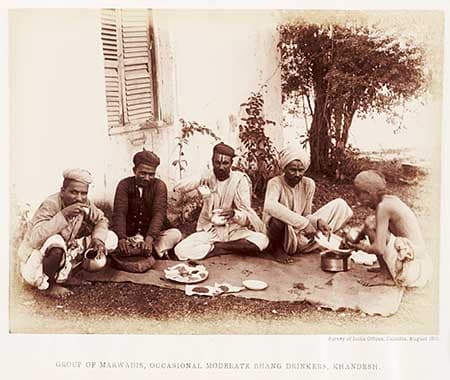
The commission that studied this photographed the people it was studying
This photograph of bhang drinkers ran in the Indian Hemp Drugs Commission’s own 1893–94 report, the seven-volume inquiry that concluded moderate use produced little harm. It is one of the few surviving images from the investigation that decided, and failed to prevent, everything that came after.
Bhang, ganja, charas: a vocabulary older than the law that borrowed it
Indian usage has always named the preparation rather than the plant. Bhang is the leaf, ground and drunk. Ganja is the flowering top. Charas is the resin, rubbed from living plants by hand.
The strength rises in that order, which is real chemistry rather than folklore. When the NDPS Act adopted these words in 1985 it inherited a classification made for tax and tradition, and gave it the force of criminal law.
Tradition is evidence of use, not evidence of safety
What history does establish
That cannabis has been used in this subcontinent continuously, openly and at scale for millennia, in ritual, in medicine and in ordinary life, and that prohibition is the recent departure rather than the norm.
What it does not establish
That any dose is safe, that adolescents are unaffected, or that a modern concentrate resembles what an eighteenth-century preparation delivered. Ancient use is a fact about culture, not a clinical finding.
What the tradition itself said
Ayurvedic texts describe bhanga as potent and to be dosed carefully, with named contraindications and warnings about excess. The classical sources are more cautious than most people who cite them.